4.8
/ 5
491 real customer reviews
Sources:
Google (309)
Herold (182)

Usually completed in a few days rather than weeks.
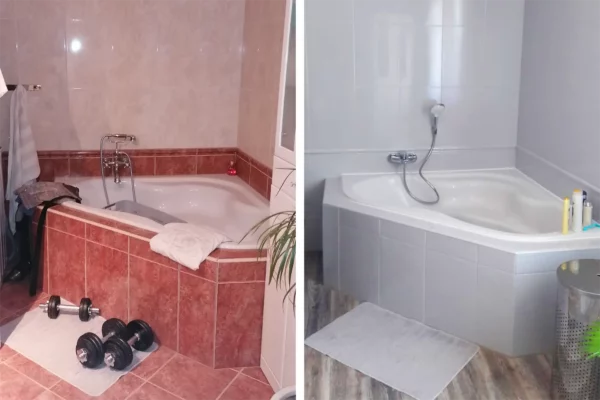 ECO bathroom Tile and bathtub resurfacing, new flooring. From €8,000.
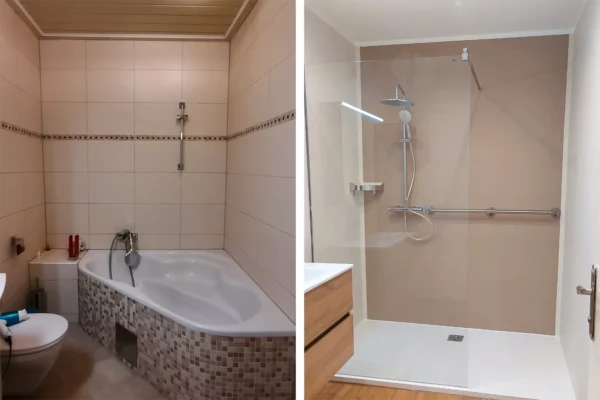 Seamless bathroom Smooth, grout-free walls, applied directly over old tiles.
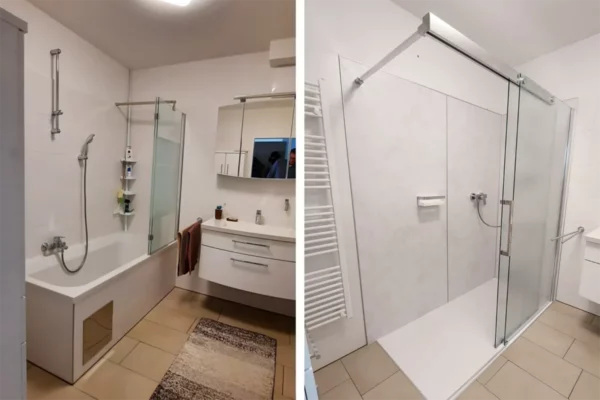 Tub out, shower in Level-access shower instead of bathtub, in 2 to 3 days.
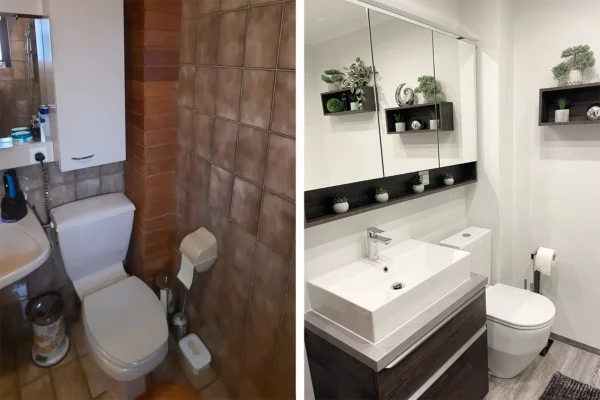 Toilet renovation Renovate the WC area at the same time.
Many tasks can be completed within a few hours or in a single day.
Many things are installed in a single day.
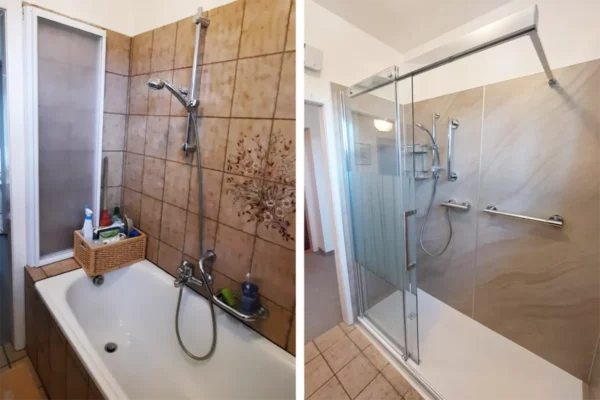 Barrier-free bathroom The entire bathroom safely planned. Grants available in Germany and Austria.
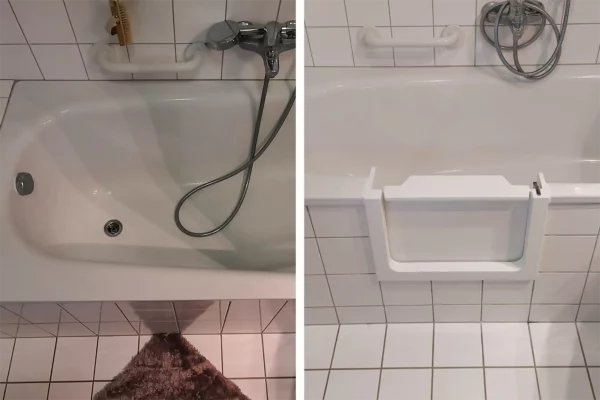 Bathtub door Step into the bath comfortably. Installation in 1 day.Tub out, shower in Level-access shower instead of a high bath rim, in 2 to 3 days.
 Make slip-resistant Slip-resistant surface for bath and shower, in around 2 hours.
Status: September 2026 · applies to Germany
There are five care levels in Germany. In 2017, they replaced the previous care stages. The applicable level is determined by an assessment based on points: from 12.5 points you receive care level 1, from 90 points care level 5. In 2026, the care allowance ranges from 347 to 990 euros per month.
Here you will find all care levels with points and amounts, how the assessment works, and how the care insurance fund supports bathroom renovations.
 Checked by Julien El-Bahy, bazuba headquartersStatus: 24 September 2026 · according to the Federal Ministry of Health and SGB XI
In short
Germany has five care levels. The level is determined by points awarded by the Medical Service during a home visit: from 12.5 points for care level 1 up to 90 points for care level 5.
Important: Benefits are available from the month in which you submit your application to the care insurance fund. An informal phone call is sufficient to meet the deadline. How the application process works
Applies to Germany. Amounts valid since 1 January 2025, unchanged for 2026; the next adjustment is scheduled for 1 January 2028. The decision of your care insurance fund is decisive. Status: 24 September 2026. Checked by Julien El-Bahy (bazuba Central Office).
The care levels are based on how independently a person can manage daily life, not on minutes of care provided. The assessment results in 0 to 100 points, which determine the care level:
| Care level | Points | Care allowance per month | Care service benefit per month |
|---|---|---|---|
| Care level 1Minor impairment of independence | 12.5 to under 27 | – | – |
| Care level 2Significant impairment | 27 to under 47.5 | 347 € | up to €796 |
| Care level 3Severe impairment | 47.5 to under 70 | 599 € | up to €1,497 |
| Care level 4Most severe impairment | 70 to under 90 | 800 € | up to €1,859 |
| Care level 5Most severe impairment with special care requirements | 90 to 100 | 990 € | up to €2,299 |
Care allowance is provided when relatives or acquaintances provide care; care service benefit applies when a care service is used. Both can be combined. Source: Federal Ministry of Health, Benefit entitlements 2026.
The federal government is planning a care reform for 2027, the Care Reorganisation Act. According to the draft bill, the point thresholds for care levels 1 to 3 are to be increased: Care level 1 from 15 instead of 12.5 points, care level 2 from 30 instead of 27, care level 3 from 50 instead of 47.5. Care levels 4 and 5 remain unchanged. It is intended that existing care levels will remain and that the law applicable at the time of application will apply to new applications. This has not yet been decided (as of 27 September 2026). Guidance on how to apply can be found in the guide Apply for care level.
Until the end of 2016, there were care levels (Pflegestufen 1 to 3, plus the so-called Pflegestufe 0) in Germany, which were mainly based on minutes of care required. Since 2017, the five care grades apply. Today, anyone searching for ‚Pflegestufen in Germany‘ is actually referring to the care grades. In Austria, they are still called Pflegestufen, and there are seven of them, see Care levels in Austria.
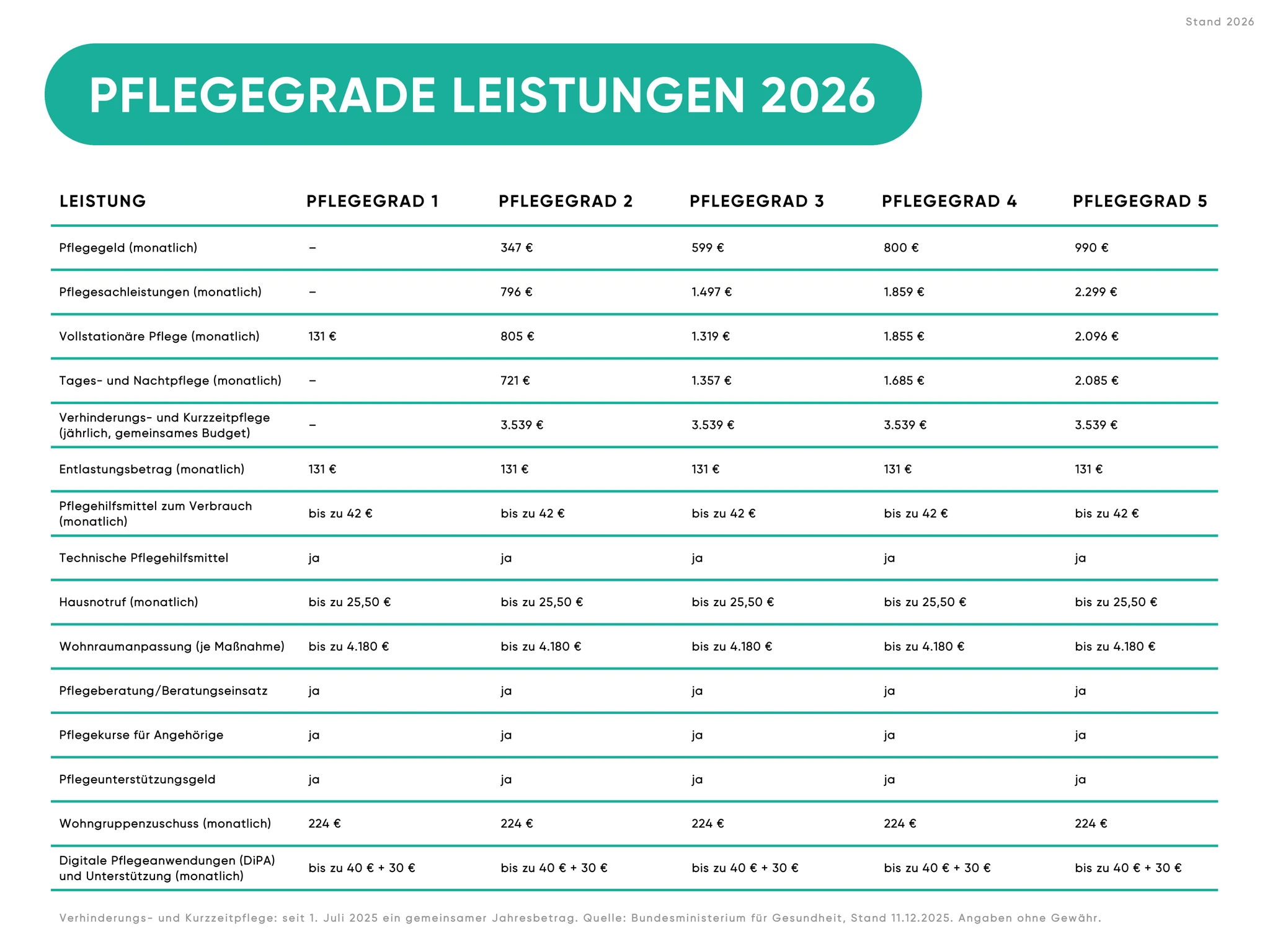
The overview is also available for printing:
After the application, the care insurance fund commissions the Medical Service, or Medicproof for privately insured persons. An assessor will visit your home by appointment and evaluate six areas of life. Two of these are assessed together, so in the end, five groups are weighted differently:
| Area | What is assessed | Weight |
|---|---|---|
| Mobility | Getting up, transferring, climbing stairs, moving around the home | 10 % |
| Cognitive and communication abilitiesor behaviours and psychological issues | Orientation, memory, following conversations; restlessness, anxiety, nocturnal restlessness. The higher of the two values applies | 15 % |
| Self-care | Washing, showering, dressing, eating, using the toilet | 40 % |
| Managing illness-related requirements | Medication, dressings, doctor visits, therapies | 20 % |
| Everyday life and social contacts | Structuring the day, keeping occupied, maintaining contact | 15 % |
Weighting according to § 15 SGB XI. Self-care counts the most: Those who need help with showering and personal hygiene are more likely to be assigned a higher care level.
In addition to care allowance and care services, there are fixed amounts that usually apply from care level 1 or 2:
| Service | Amount 2026 | From care level |
|---|---|---|
| Relief allowancefor everyday assistance, care, household help | €131 per month | 1 |
| Home environment improvement measuresfor example, shower instead of bathtub, bathtub door | up to €4,180 per measure | 1 |
| Consumable care aidsGloves, disinfection, bed protection | €42 per month | 1 |
| Respite and short-term carecombined annual amount since 1 July 2025 | €3,539 per year | 2 |
| Day and night care | €721 to €2,085 per month | 2 |
| Full inpatient care | €131 to €2,096 per month | 1 |
| Shared living group supplement | €224 per month | 1 |
| Digital care applications | 40 € plus €30 support per month | 1 |
Source: Federal Ministry of Health, benefit entitlements 2026. Your care insurance fund or a care support centre will clarify details and requirements.
You submit the application to the care fund, which is located at your health insurance provider. A phone call or an informal letter is sufficient; the form will be sent to you afterwards. Benefits are available from the month in which the application is submitted, even if the decision is made at a later date. The care fund is generally required to decide on the application within 25 working days. The step-by-step process is explained in the guide Apply for care level.
You can appeal the decision in writing within one month, providing a brief justification. Request the assessment report if it is not included, and note any limitations that are missing. If the rejection remains, you may file a claim with the social court; there are no court fees for insured persons. If the condition worsens later, you can apply for a higher level.
Is your bathroom becoming an obstacle? In Germany, the care insurance fund contributes up to €4,180.Bathtub door in 1 day, shower instead of a bathtub in 2 to 3 days. Free inspection with a quote for your application.
In Germany, the care insurance fund pays an allowance for every care level, starting from care level 1, up to €4,180 for a measure that facilitates home care. A typical example is the bathroom: a low-entry bathtub or a level-access shower. If several people in need of care live in the household, up to €16,720 is possible.
The order of steps is important: first submit the application with a quote to the care insurance fund, then place the order. How this works, including a sample application, can be found in the guide Bathroom conversion with the care fund.
The portion not covered by the care insurance fund can be partially deducted via the tax bonus for tradesman services, see Deduct bathroom renovation from tax. Without a care level, there is no KfW Loan 159.
Five. Care level 1 is granted from 12.5 points in the assessment, care level 5 from 90 points. The previous care stages have not existed since 2017.
Care level 2: €347, care level 3: €599, care level 4: €800, care level 5: €990 per month. For care level 1, there is no care allowance, but the relief amount of €131 per month.
No. The care stages were replaced by five care levels in 2017. Anyone who had a care stage at that time was automatically transferred. In Austria, the stages are still called care stages, and there are seven.
Care level 1: 12.5 to under 27 points, care level 2: 27 to under 47.5, care level 3: 47.5 to under 70, care level 4: 70 to under 90, care level 5: 90 to 100 points.
It is planned. According to the draft bill for the Care Reorganisation Act, the point thresholds for care levels 1 to 3 are to be increased; care level 1 would then only apply from 15 points instead of 12.5. Existing care levels are to remain unchanged. This has not yet been decided (as of 27 September 2026).
The Medical Service on behalf of the care fund, or Medicproof for privately insured persons. The assessment usually takes place during a scheduled home visit; the decision is then made by the care fund.
The care fund must usually make a decision within 25 working days. Benefits are granted retroactively from the month the application is submitted.
You may file a written objection within one month of receiving the decision, ideally including the assessment and a list of any limitations not mentioned there. After that, you may file a claim with the social court, with no court fees for insured persons.
Yes, in Germany from care level 1, up to €4,180 per measure, for example for a bathtub door or a shower instead of a bathtub. The application must be submitted before commissioning the work.
The relief amount of €131 per month, up to €4,180 for a renovation such as in the bathroom, €42 per month for consumable care aids, as well as care counselling. Care allowance and care benefits in kind are only available from care level 2.
Yes, as a combined benefit. For example, if you use half of the care benefit in kind for a care service, you will also receive half of the care allowance paid out.

The application step by step, with deadlines and tips for the assessment.
Up to €4,180 from care level 1: how the application works, with a sample.

What a bathroom needs for older people, with dimensions, costs and funding.
„On the recommendation of a friend, we got in touch with bazuba Rostock for our bathroom renovation. Since it’s a rental apartment, there were quite a few things to consider with the landlord/owner’s approval, but we were able to implement many individual wishes at our own expense. The initial contact was very pleasant, and first, an assessment was made, and of course, the initial ideas and wishes for the project were recorded. The basic task was to transform the over 20-year-old tiled bathroom with an old bathtub into a modern seamless bathroom with a walk-in rain shower. The company’s showroom had quite a few displays, where we could get our first personal impressions. Then we put together the rest from the catalogs, and we also relied on the advice and recommendations of the boss there, who contributed some great ideas. Then we received an offer with a 3D visualization of the finished bathroom. This allowed us to work very well together with the owner and bazuba on the details and arrive at a final result. The correspondence between bazuba and the owner also went very smoothly, and we were very well informed about delivery times, construction times, and the entire process up to the finished bathroom. We helped set up the construction site by covering the floor and cabinets, and the company’s employees were very friendly and informative about the work steps. We hardly had to ask anything because every morning we were informed about what would happen that day until quitting time. The announced construction time was even undercut by 2 days because everything really fit together, and the trades worked hand in hand. The handover and the finished result, including explanations of all the components, care instructions, and warranties, worked wonderfully and were presented to us very transparently. All in all, we are very satisfied with the result, and for the small space available, it almost feels like being in a good hotel when you step into the shower in the morning 😉 I can definitely recommend bazuba Rostock and am happy to show some before-and-after pictures. It’s not decorated or furnished yet, but it’s about the raw result."
Auto-translated from German
„Due to water damage in 2023 and subsequent repair work by a specialist company, we were then looking for a company to get our bathroom back in shape. This turned out to be not so easy; local companies either declined due to lack of time or didn’t show up despite appointments. Through internet research, we came across bazuba in Karlsruhe. We quickly had a first appointment with Mr. Glutsch. He arrived on time at our place, listened to our ideas about remodeling the bathroom, and shared his professional knowledge and comments. He took measurements, made notes, and promised to prepare an offer, which arrived in the shortest time. Due to several work appointments with bazuba, he already told us in advance that the work would be delayed and we should expect a date in March/April. But that didn’t matter to us in the end, since thanks to the preliminary work of the renovation company, we could still use our 30-year-old bathroom. When choosing the ceramics and the walk-in shower, we were with Mr. Glutsch at C.Ufer in KA (top advice!). In April, the work started on our partially renovated bathroom. After about 2 weeks, we could fully use our new bathroom; for the shower enclosure, we had to make do with a temporary solution, which was replaced after 5 weeks by a glass partition from Kermi. All in all, we were very impressed by the support and advice from bazuba (special thanks to Mr. Glutsch). A big compliment to the two skilled workers responsible for the work!! Without a doubt, 5 stars for bazuba."
Auto-translated from German
„Big praise! As part of a planned bathroom remodel and a visual upgrade, we were looking for a company that understands a bathroom renovation also as a renovation and/or partial remodel, and doesn’t start out with the philosophy and advice: "best to gut everything and start completely new..." From the first contact after internet research, on-site and showroom consultation, to the creation of a fair offer and the final execution of the agreed services, everything was excellent. Nowadays, it’s no longer a given that, for example, in sales talks, cheaper alternatives are honestly and openly discussed, or that the involved craftsmen work well beyond their usual finishing times multiple times to keep the scheduled timeframe for the customer. At any time, unexpected special features and surprises were handled flexibly and suitable alternatives were implemented. After the work was completed, the handover showed flawless completion with very good quality regarding seamless wall coating, pre-wall installation, walk-in shower, new designer floor, etc."
Auto-translated from German
„Bathroom grout renovation/Bathroom fan replacement/Water heater replacement A great team! I've used the Bazuba team a total of three times. Each time, the necessary repair was done quickly and carefully, even though these were rather small jobs. Getting in touch directly through the website is easy, and the work gets done smoothly, even though I don't live on site and have to manage the repairs from 600 km away. I was especially impressed by the thoroughness and initiative when Mr. Otte asked for the caretaker's or property management's number to arrange the replacement of a fuse in the basement, which is not publicly accessible. You rarely find that kind of commitment. I'm glad to have found Mr. Rausch and the bazuba team."
Auto-translated from German
„The day before yesterday and yesterday, Mr. John Sarkösi repaired the bathtub in our beautiful guest bathroom. The repair became necessary after water damage destroyed the electronics of the whirlpool inside the tub. Installing a new whirlpool would have been too complicated for various reasons. I happened to discover the company bazuba online, and after several inquiries, they offered to repair the tub without having to remove it. Mr. Sarkösi did an excellent job, and the tub looks like new again. Mr. Sarkösi was very friendly and worked very cleanly. We were completely satisfied. Really recommendable. Many thanks, Helmke Priess"
Auto-translated from German
„Very professional and excellent support from the consultation with Mr. Seper, through the handling of the renovation, to the completion of the project. All appointments were kept punctually as agreed. Great importance was placed on cleanliness, and the construction site was never left without cleaning up. The collaboration was almost friendly. The result speaks for itself; it turned out very nicely. Big praise to the entire team at bazuba/Guntramsdorf and especially to Mr. Delic's team. The cohesion and the "togetherness" were clearly noticeable. Gladly again anytime! What else do you renovate? A heartfelt thank you! Silvia Holly"
Auto-translated from German
„Very happy with our new bathroom Many thanks to Herbel Bädertraum – a bazuba specialist company – for renovating our bathroom. From the first contact, it was a very pleasant collaboration. Mr. Herbel gave us excellent advice, took plenty of time, and was always available to answer questions and discuss our requests. The remodel of our small bathroom took 11 working days; everything was perfectly planned and coordinated. The craftsmen were friendly and accommodating, offered suggestions, and made adjustments according to our wishes. We are very satisfied with the quality of the work and the result. Many thanks and our unreserved recommendation."
Auto-translated from German
We will inspect your bathroom free of charge and prepare the quotation you need for your application to the care insurance fund. We will provide the fixed price after the inspection. Prefer to call? Free of charge at 0800 90 44 2000.
Sie sehen gerade einen Platzhalterinhalt von Vimeo. Um auf den eigentlichen Inhalt zuzugreifen, klicken Sie auf die Schaltfläche unten. Bitte beachten Sie, dass dabei Daten an Drittanbieter weitergegeben werden.
Mehr InformationenSie sehen gerade einen Platzhalterinhalt von YouTube. Um auf den eigentlichen Inhalt zuzugreifen, klicken Sie auf die Schaltfläche unten. Bitte beachten Sie, dass dabei Daten an Drittanbieter weitergegeben werden.
Mehr Informationen